
Endometriosis is a common benign gynecological disease affecting women of reproductive age group. It is defined as the presence of functional endometrium (both endometrial glands and stroma)outside the uterus. Most commonly it affects organs of the pelvic cavity: ovaries, fallopian tubes, urinary bladder, intestines or peritoneum (1). Rarely, it is localized in other organs outside …

Endometriosis is a common benign gynecological disease affecting women of reproductive age group. It is defined as the presence of functional endometrium (both endometrial glands and stroma)outside the uterus. Most commonly it affects organs of the pelvic cavity: ovaries, fallopian tubes, urinary bladder, intestines or peritoneum (1). Rarely, it is localized in other organs outside the pelvis—diaphragm, pleura, abdominal wall, central or peripheral nervous system. Endometriosis affects about 5-20 percent women in the reproductive age group globally and approximately 42 million in India.
Endometriosis has variable range of manifestations , it is also called disease of theories as no one theory can explain all cases. Most commonly theory of retrograde menstruation and immunological theory. Retrograde menstruation is where menstrual blood flows backward into the pelvic cavity. This process can deposit viable endometrial cells that form lesions, particularly in the peritoneal area. Research shows that people with endometriosis have higher risk of developing immune-related conditions such as rheumatoid arthritis, osteoarthritis, coeliac disease, multiple sclerosis, and psoriasis.
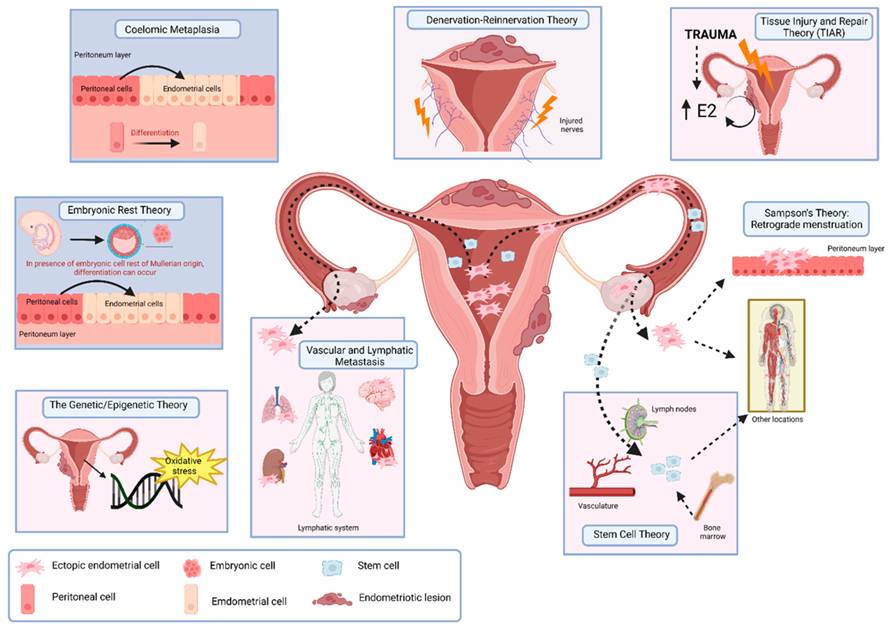
What are the symptoms of endometriosis?
Most commonly
- Pain -Chronic pelvic pain ,
- Dysmenorrhea
- Dyspareunia-pain during intercourse
- Infertility
- Heavy menstrual bleeding
- Difficulty in defecation
- Difficulty in micturition
Rest depending on the site of involvement.
What are they investigations for diagnosing endometriosis?
- Complete blood count
- Urine analysis and culture to rule out the urinary tract infection
- Diagnostic imaging like ultrasound(TVS or TAS) and magnetic resonance imaging(MRI)
- Barium swallow and enema for intestinal endometriosis
- Cystoscopy to detect bladder involvement
- Sigmoidoscopy and biopsy to detect colorectal endometriosis
- Laparoscopy -which is the most important modality to diagnose, quantify and classify endometriosis.
How to treat endometriosis?
Decision making depends on individual preferences which can be either medical or surgical treatment.
- Medical treatment
- Non-steroidal anti-inflammatory drugs to reduce the pain.
- Combined hormonal contraception which can be given for 6 to 12 months.
- Progestogens (Medroxyprogesterone acetate , Dydrogesterone , Dienogest , LNG-IUS) for 6-9 months
- GnRH agonists (Goserelin , Leuprolide acetate , Treptorelin) for 3-6 months. Calcium is also given along with it.
- GnRH antagonist like Elagolix in low or high dose.
- Aromatase inhibitors (Letrozole or Anastrozole) for 6 months.
- Surgery – Laproscopic or laparotomy.
Can we treat infertility in endometriosis?
Yes, there are various effective treatments such as
- Ovulation induction controlled
- Controlled Ovarian hyperstimulation
- Intrauterine insemination
- In vitro fertilization
- Embryo transfer
- Intracytoplasmic sperm injection
Can endometriosis recur?
Yes , the recurrence rate of endometriosis is very high after the medical therapy or conservative surgery. It can be prevented by giving long term post operative hormone treatment.
Patient awareness have promoted a more holistic approach to treatment and increased adoption of self-help strategies that are helping some individuals reduce the severity of symptoms and improve Quality of life. With a wide range of options now emerging it is important that patients are given advice on how they might adopt self-help strategies such as the use of apps, adjustments to their diet, CBT/mindfulness training and physical therapies as a complement to any conventional medical/surgical treatment.
Reference : Philippa T K Saunders, Andrew W Horne, Endometriosis: new insights and opportunities for relief of symptoms, Biology of Reproduction, Volume 113, Issue 5, November 2025, Pages 1029–1043, https://doi.org/10.1093/biolre/ioaf164
For correspondence : Dr Rusa Mitra (MBBS , MS Obstetric and Gynaecology)
Affiliated to Kasturi Medical Centre pvt ltd, Thakurpukur .
